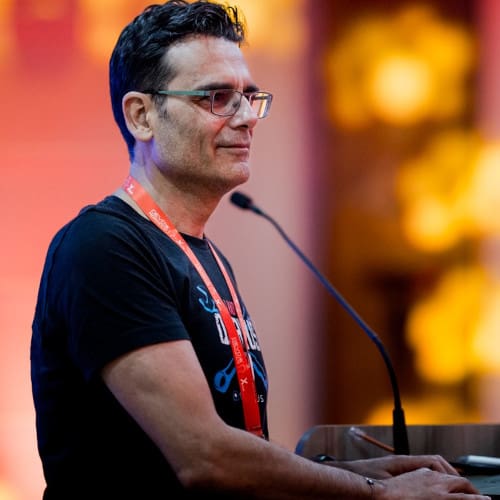
Dimitris has 25 years of experience in IT and he is Director of Engineering at Red Hat in charge of the Cloud Native Runtimes group that includes Quarkus, Vert.x, SpringBoot, Node.js, as well as the WildFly&JBoss Enterprise Application Server. He also served as the JBoss AS project lead and he has been a JBoss addict and contributor from the early start-up days. He worked previously at Intracom and Motorola in the areas of NMS/OSS, designing reusable frameworks and distributed systems. Dimitris studied computer science at the Technological Educational Institute of Athens and received an M.Sc. by research from University College Dublin, Ireland.
Dimitris is a passionate advocator of Opensource & Red Hat technologies and has presented on a variety of events and conferences around the world. He has been an invited speaker at various Java/Linux community events and user groups, and he has delivered inspirational talks on technology and Open Source in universities and educational institutes. In his spare time he has also helped with the organization of technology enablement events for children, like Scratch Days, Devoxx4Kids and JCrete4Kids.
Dimitris has 25 years of experience in IT and he is Director of Engineering at Red Hat in charge of the Cloud Native Runtimes group that includes Quarkus, Vert.x, SpringBoot, Node.js, as well as the WildFly&JBoss Enterprise Application Server. He also served as the JBoss AS project lead and he has been a JBoss addict and contributor from the early start-up days. He worked previously at Intracom and Motorola in the areas of NMS/OSS, designing reusable frameworks and distributed systems. Dimitris studied computer science at the Technological Educational Institute of Athens and received an M.Sc. by research from University College Dublin, Ireland.
Dimitris is a passionate advocator of Opensource & Red Hat technologies and has presented on a variety of events and conferences around the world. He has been an invited speaker at various Java/Linux community events and user groups, and he has delivered inspirational talks on technology and Open Source in universities and educational institutes. In his spare time he has also helped with the organization of technology enablement events for children, like Scratch Days, Devoxx4Kids and JCrete4Kids.
Model Context Protocol (MCP) is an open standard that enables seamless integration between LLM based applications and agents with external systems, thus allowing us to dynamically enhance the model/agent that acts as a client, with capabilities provided by connected MCP servers.
The Quarkus project created one of the first MCP implementations in Java. Quarkus provides an ideal runtime for coding intelligent applications and agents that use the MCP protocol to call out to external MCP servers, or conversely, let you implement powerful MCP servers that can be invoked by any compliant LLM based application written in any programming language.
Whether you want to connect to your favorite database, integrate with your company’s systems, or build something completely new, everything is possible! Quarkus will handle all the MCP plumbing and through its hundreds of extensions will help you implement any simple or complex enterprise integration scenario that can enhance your intelligent workflows.
Come to this talk to learn how MCP works and how to use it effectively with Quarkus.
Open Source Software (OSS) may have taken over the world, but did someone take control of OSS itself in the process, locking it into a proprietary platform, controlled by a single vendor? Is this still a sustainable path today, in the time of trade wars, volatile tariffs, GenAI mandates and countries fighting for data sovereignty? The future of OSS as a global public good is at risk. The need for a resilient, community-owned alternative has never been more urgent.
This talk will introduce you to Radicle, a new, decentralized code forge that’s built on a peer-to-peer architecture.
We’ll explore how Radicle works and how it extends Git to create a secure and resilient network for code collaboration. We’ll cover its peer-to-peer replication protocol, its decentralized identity system, and its novel approach to code discovery.
This talk is for developers of all levels interested in the future of Open Source. You’ll leave with a better understanding of the challenges involved in designing and running distributed, peer-to-peer systems. You’ll also learn how you can start mirroring / migrating your code to the Radicle network, so you can #FreeYourCode !
Interactive storytelling is often treated as a writing problem. In practice, it quickly becomes a systems design challenge.
While building Choose Your Fate, a platform for creating and reading interactive stories, we came to understand what makes the medium genuinely challenging: branching paths that create contradictions across a story, pacing that breaks down as choices multiply, reader agency that feels real but requires careful construction to actually be meaningful. The structure holding the story together turns out to be as demanding as the story itself.
This talk is about what we learned treating narrative as an engineering and craft problem.
We’ll walk through how stories behave like graph systems once you introduce branching, why complexity grows faster than it looks, and how specific structural patterns (diverging, converging, looping, state-persistent) can keep a story coherent while preserving genuine reader agency. A recurring pattern in existing systems is flat choices that carry no real consequence, or meaningful decisions locked behind a monetization layer rather than a narrative one.
We’ll look at the product side too: what it takes to build tools for writers who don’t think in systems, and how you design interfaces that support system-level thinking without asking creators to become engineers.
We’ll also cover how AI fits in this creative space without alienating the creators: not as a story generator, but as something closer to a structural editor that can flag pacing problems and suggest where choices belong.
Attendees will leave with:
– A clearer mental model for why interactive narratives break down and how to prevent it
– Structural patterns that balance branching complexity with story coherence
– Design lessons from building a creator platform for interactive storytelling
– A realistic view of where AI helps in creative tools and where it doesn’t
What is logging, in one word? Cost. Undeniably.
Development cost. Performance cost. Operational cost. Maintenance cost.
But is logging truly costly, or merely expensive?
As with education, the answer depends on outcomes, and those outcomes only become visible over time.
By approaching logging the way we approach learning, we can transform a controversial expense into an operational necessity.
We employ a discreet but continuous source of insight across business, development, architecture and design, security, and incident response.
When designed intentionally, logs tell stories about both system and human behaviors.
They reveal how our services actually run and where assumptions quietly fail.
In that sense, observability through logging is not a sunk cost, but a high-return investment in understanding and decision-making, potentially offering a multi-aspect business intelligence solution.
In this talk, we explore how to extract real value from logging by mapping it to three universal dimensions of learning:
-Things we know that we know
-Things we know that we do not know
-Things we do not know that we do not know
What if your engineering team could move at the speed of AI – without sacrificing quality, security, or control? Enter the Agentile Team: a lean, AI-powered, and platform-enabled evolution of Agile, designed to amplify human creativity.
In this session, we’ll explore how Agentile teams codify architectural tradeoffs (security, capacity, cost) into specs, templates, and guardrails, enabling rapid experimentation and smarter decision-making from day one. Drawing on real-world experiments and platform engineering principles, Suzanne will share practical strategies for developers and platform engineers to thrive in this new era of agentic, high-velocity software delivery.
Most developers use AI coding tools like a search engine: type a question, hope for a good answer. But the teams getting real results are engineering the context: configuring system prompts, structuring project knowledge, and managing the AI’s working memory like a first-class architectural concern.
This workshop is built around a real coding project. Participants will receive a small application to build – and throughout the session, they’ll apply each technique as they learn it, experiencing firsthand how context engineering transforms their AI’s output quality.
We’ll cover:
– **The context window** – what tokens are, what counts as context, and why your AI gets worse mid-conversation (context rot)
– **Basic prompting techniques** – prompt engineering is no longer as important, but can still improve your results
– **System prompts as project configuration** – set up instruction files (CLAUDE.md, copilot-instructions.md) that make every AI interaction project-aware
– **Grounding techniques** – anchor AI output in real data instead of letting it guess, using file uploads, documentation references, and structured retrieval
Each concept is immediately put into practice on the project – so by the end, participants will have both a working application and a repeatable playbook for getting better results from any AI coding tool.
Targeted to software engineers, bring a laptop with an AI coding assistant installed.
Nobody’s talking about this: MCP isn’t just another way to build chatbots. It’s the bridge we’ve been missing between AI reasoning and real-time data systems.
Teams build AI applications that work great in demos but fall apart with production data. Your agents analyze historical reports but can’t tell what’s happening in your Kafka streams. They’re blind to schema changes and disconnected from events that matter to your business.
Instead of treating streaming platforms like black boxes, you expose them directly to your agents via MCP protocol. Suddenly, your AI doesn’t just read about data—it lives inside your data flows.
Learn what becomes possible when you stop thinking about AI as an external service and start treating it as part of your streaming architecture. We’ll build systems where agents subscribe to real-time events, reason about evolving schemas, and make decisions that ripple through your data platform.