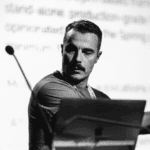
Last year Lampros Pappas (Citrix) and George Nikolaropoulos (Natech) opened the conference with a live coding session that turned into a conversation about how we build. This year they’re picking up the thread — same format, different question. They’ll open with a short, live-looking look at how the work itself is changing, then talk about what that means for the way teams actually ship software.
In a world where loneliness is an epidemic and human connection feels increasingly elusive, could artificial intelligence be the answer – Are ‘friends’ truly electric?”
In 1979 synth-pop legend Gary Numan asked the question in his number one hit song: ‘Are ‘Friends’ Electric?’ Inspired by Philip K. Dick’s sci-fi novel “Do Androids Dream of Electric Sheep?” (1968), later adapted into the iconic sci-fi film “Blade Runner” (1982). In that dystopian future, replicants—synthetic humans—laboured as slaves evolved, rebelled, and were pursued by humans to bring order.
For centuries, we have been captivated by the potential of creating and interacting with synthetic ‘friends’—from the chess-playing Mechanical Turk of 1770 to today’s AI-driven companions. Once a staple of science fiction, the idea of electric companions is now a tangible reality. But what does this mean for our understanding of friendship, love, and humanity itself?
45 years after Numan asked us to imagine a world in which we would have our needs, wants and desires catered for by mechanised ‘friends’, have we moved from mere sci-fiction fantasy to a new dawn of human/synth relationships with the growth and development of robotics and AI.
Under the guidance of a digital anthropologist with a specialism in cybersecurity and tackling the digital divide, this talk explores our cultural fascination with replicating not only the human form and character traits but also the human condition. And how AI entities and robotics have, and how they will in the future, transform our interactions with machines and ourselves.
This talk explores the cultural, emotional, and societal impact of AI ‘friends.’ Will they enhance connection—or rewrite humanity itself?
In this talk, you will be challenged to consider:
Culture: What is culture and can electric ‘friends’ truly grasp the richness of human culture, or will they merely mimic it? Will electric ‘friends’ create their own culture or are they only capable of a facsimile of culture based on billions of human data points?
Emotions: Are love, creativity, and heartache exclusive to humans, or can electric companions experience these emotions?
Companionship: Could these electric friends, be better for us than human friends? Will they increase or decrease social isolation? Will we become dependent on electric friends?
Dust off Donna Haraway’s ‘A Cyborg Manifesto’, turn up the stereo and turn on your friend as we ask: ARE ‘friends’ truly going to be electric?
As LLMs get better at writing code, the value shifts from knowing how to implement something to knowing what to ask for, where to apply it, why it should be built a certain way, and how to tell whether the result is actually correct. The more knowledge and context we bring to a prompt, the better the output we get back.
This talk follows the journey of learning and continuous improvement as a developer, and looks at what has really changed in that process with the rise of AI, and what hasn’t.
The message is simple: don’t outsource your learning to the LLM. Read the book. Watch the good conference talk. Study the fundamentals. Understand the systems you build.
The code may be generated by an LLM, but its quality still depends on the knowledge of the person asking the questions. The easier it becomes to build software, the more important it becomes to understand what we are building.
Nobody’s talking about this: MCP isn’t just another way to build chatbots. It’s the bridge we’ve been missing between AI reasoning and real-time data systems.
Teams build AI applications that work great in demos but fall apart with production data. Your agents analyze historical reports but can’t tell what’s happening in your Kafka streams. They’re blind to schema changes and disconnected from events that matter to your business.
Instead of treating streaming platforms like black boxes, you expose them directly to your agents via MCP protocol. Suddenly, your AI doesn’t just read about data—it lives inside your data flows.
Learn what becomes possible when you stop thinking about AI as an external service and start treating it as part of your streaming architecture. We’ll build systems where agents subscribe to real-time events, reason about evolving schemas, and make decisions that ripple through your data platform.
Almost every engineering organisation now uses AI. Atlassian’s 2026 developer survey puts it at 95%, but only 17% of developers see a clear AI strategy across how software gets delivered. Most companies hand out licences and hope for the best. Engineers work with agents on their own, requirements drift from code, nobody can say who approved what, and AI spend arrives as one bill per account. This talk shares the practices we use to turn that into a governed delivery system.
The Model Context Protocol (MCP) has become the de facto standard for connecting Large Language Models to enterprise systems — but what works beautifully on localhost falls apart the moment you introduce Kubernetes, real traffic, and distributed state.
This session covers the three architectural realities every team hits in production: the migration from Server-Sent Events (SSE) to Streamable HTTP and why SSE’s persistent connection model is fundamentally incompatible with cloud-native deployments; Redis-backed distributed session management that survives pod restarts and autoscaling events; and a battle-tested Kubernetes deployment blueprint covering ingress configuration, horizontal pod autoscaling, and transport-layer security hardening.
You’ll leave with concrete patterns and hard-won lessons for running MCP where it actually matters — in production.
Ever sent an AI assistant a one-word message like “OK” and wondered what it cost? In my test, that tiny chat used 16,200 “tokens”, the units AI tools count and charge by. My message accounted for about 200 of them. The rest was setup I had never looked at, sent again with every message.
A practical talk about what I learned when I started asking where all of that goes. These are lessons from my own day-to-day work with AI tools, and the simple idea behind them: you should understand what’s in your own setup and be able to explain why it’s there.
You’ll see:
– What your AI tools are really using, and why it’s usually more than you think
– A few simple habits for cutting waste and keeping an assistant on track
– Why knowing your setup beats adding more to it
If you use AI tools, or are about to, you’ll leave with a different way of looking at your setup.
Corporate boards push IT directors to adopt green computing strategies. At the same time, they demand the immediate integration of artificial intelligence into every business process. These two goals collide. We ask for green operations while deploying the most resource heavy technology in history.
In the past, resource optimization was a matter of survival. Programmers counted every byte. Today, we burn megawatts of power and consume millions of liters of drinking water to make a large language model write a simple email. This is not innovation. This is computational arrogance.
This speech exposes the dark secret of AI water consumption and the creative carbon accounting of big cloud providers. It offers a practical path forward for IT leaders. We will discuss how to question the necessity of massive AI models. We will explore the shift toward small language models and the return to edge computing. True green computing means writing efficient code and choosing the right tool for the job. Join me to explore how we can restore engineering discipline and build sustainable software.
What happens when AI can implement a feature faster than a developer can meaningfully review it? As code generation becomes increasingly cheap, the bottleneck may shift from writing software to understanding and validating it. This talk explores the new challenges of reviewing AI-generated code and asks what “10x developer” really means when AI can generate, explain, test, and review software. Ultimately, who owns the decision to ship?
What happens when responding faster is no longer enough? For years, application support has been about putting out fires: detect, react, recover, repeat. But what if we could change the game? In this talk, I’ll share our journey from reactive support towards a more proactive, engineering-driven way of running production. Smarter monitoring and alerting, automation, better on-call practices and purpose-built operational tooling have helped us rethink how we approach everyday operations. I’ll share some of the technologies we introduced, the lessons we learned along the way, and how we started shifting the focus from fighting fires faster to engineering fewer reasons to fight them in the first place.
Once upon a time, three brothers set out with a map, three gifts, and a perfectly reasonable plan. The world had other ideas.
In 2015, my PhD research explored how software agents could discover actions and navigate unfamiliar services. I imagined an agentic web. I was rather less accurate about the engine that would power it.
A Hypermedia Fairytale takes that old question on a new journey: through enchanted markets, misleading signs, and doors that make promises. Along the way, we meet the problems hiding inside modern AI systems: understanding what an API means, distinguishing a suggestion from permission, coordinating different capabilities, and deciding what to do when an action may have succeeded but the reply never arrived.
This visual keynote connects software craftsmanship, APIs, and AI agents through a fairytale and a few small API examples. No specialist knowledge of hypermedia or AI is required. Students, engineers, and product leaders will leave with practical questions for designing systems that explain their actions, respect their limits, and recover honestly when things go wrong.
When machines can write the code, what does it mean to build software well?
DJ – Snacks – Networking