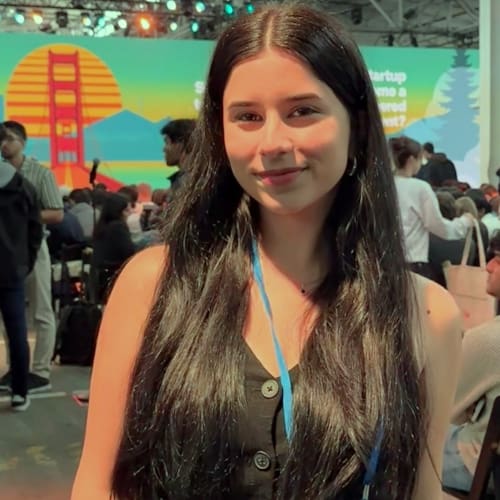
I’ve been building digital products since I was 14, driven by a deep curiosity to turn ideas into tools that solve real problems. One of my first personal projects was an AI tutor I built to prepare for Greece’s national exams; using it daily helped me score in the top 0.1% nationwide without external instruction. I documented the journey in a YouTube video that’s now been viewed over 70,000 times.
Since then, I’ve contributed to open-source projects, shipped production-ready tools for startups, and competed in 10+ hackathons, winning first place in 3 of them. I’m currently a Software Engineer and DevRel at NOFire AI, where I work on both the engineering side and public-facing developer relations. That’s taken me on stage to speak at React Summit on Gen Z builders shipping to production while still in school, and to run a hands-on vibecoding workshop at Open Conf. I’ve also attended YC’s AI Summit, staying close to the frontier of where the AI builder space is heading.
Alongside engineering, I’m a tech content creator with over 2M views across my content, posting as @artemis.codes and @artemisvibecodes. I make educational content on AI-assisted building and prompting techniques, informational content on upcoming tech events and what’s happening in the space, and AI-focused content covering tools and workflows. I’m also a UGC creator for Lovable, making content that shows real builds with real prompts, not just polished demos. I thrive in fast-paced, problem-solving environments and love creating technology that moves quickly from prototype to real-world use, and increasingly, in helping other people do the same.
The traditional barrier to entry for building software is gone. We have officially entered the era of “Vibecoding” and Agentic Engineering, where AI agents act as your personal development team, and your main job is to orchestrate them.
In this highly interactive, 60-minute code-along workshop, we will demystify AI-Augmented Development. You don’t need months of tutorials to build a startup MVP. Together, we will build a functional booking platform UI (an “Airbnb clone”) from scratch using Next.js and Tailwind CSS, entirely guided by AI.
Zero Setup Required: We will use browser-based AI IDEs (like Replit Agent or v0 by Vercel) so you can start building immediately without installing anything.
Workshop Agenda (60 Minutes):
[00:00 – 00:10] The New Builder Stack & R.A.C.E. Framework: Introduction to Agentic Engineering and how to write production-grade prompts (Role, Action, Context, Expectation).
[00:10 – 00:25] Generating the Foundation: Setting up our web IDE and prompting the AI to generate our core Next.js & Tailwind CSS layout (navbars, hero sections, property grids).
[00:25 – 00:45] Iteration & Fixing Hallucinations: AI isn’t perfect. We will learn how to act as “Tech Leads” to debug, refine the UI, and add interactive booking components.
[00:45 – 00:55] The Magic Trick (Live Deployment): With one click, we will deploy our web apps live to the internet. You will leave this room with a working public URL on your phone!
[00:55 – 00:60] Q&A & Next Steps: How to take your MVP to the next level.
Prerequisites: Just bring a laptop and your creativity! No prior React/Next.js experience is strictly required, though a basic understanding of how websites work is helpful.
Open Source Software (OSS) may have taken over the world, but did someone take control of OSS itself in the process, locking it into a proprietary platform, controlled by a single vendor? Is this still a sustainable path today, in the time of trade wars, volatile tariffs, GenAI mandates and countries fighting for data sovereignty? The future of OSS as a global public good is at risk. The need for a resilient, community-owned alternative has never been more urgent.
This talk will introduce you to Radicle, a new, decentralized code forge that’s built on a peer-to-peer architecture.
We’ll explore how Radicle works and how it extends Git to create a secure and resilient network for code collaboration. We’ll cover its peer-to-peer replication protocol, its decentralized identity system, and its novel approach to code discovery.
This talk is for developers of all levels interested in the future of Open Source. You’ll leave with a better understanding of the challenges involved in designing and running distributed, peer-to-peer systems. You’ll also learn how you can start mirroring / migrating your code to the Radicle network, so you can #FreeYourCode !
Interactive storytelling is often treated as a writing problem. In practice, it quickly becomes a systems design challenge.
While building Choose Your Fate, a platform for creating and reading interactive stories, we came to understand what makes the medium genuinely challenging: branching paths that create contradictions across a story, pacing that breaks down as choices multiply, reader agency that feels real but requires careful construction to actually be meaningful. The structure holding the story together turns out to be as demanding as the story itself.
This talk is about what we learned treating narrative as an engineering and craft problem.
We’ll walk through how stories behave like graph systems once you introduce branching, why complexity grows faster than it looks, and how specific structural patterns (diverging, converging, looping, state-persistent) can keep a story coherent while preserving genuine reader agency. A recurring pattern in existing systems is flat choices that carry no real consequence, or meaningful decisions locked behind a monetization layer rather than a narrative one.
We’ll look at the product side too: what it takes to build tools for writers who don’t think in systems, and how you design interfaces that support system-level thinking without asking creators to become engineers.
We’ll also cover how AI fits in this creative space without alienating the creators: not as a story generator, but as something closer to a structural editor that can flag pacing problems and suggest where choices belong.
Attendees will leave with:
– A clearer mental model for why interactive narratives break down and how to prevent it
– Structural patterns that balance branching complexity with story coherence
– Design lessons from building a creator platform for interactive storytelling
– A realistic view of where AI helps in creative tools and where it doesn’t
What is logging, in one word? Cost. Undeniably.
Development cost. Performance cost. Operational cost. Maintenance cost.
But is logging truly costly, or merely expensive?
As with education, the answer depends on outcomes, and those outcomes only become visible over time.
By approaching logging the way we approach learning, we can transform a controversial expense into an operational necessity.
We employ a discreet but continuous source of insight across business, development, architecture and design, security, and incident response.
When designed intentionally, logs tell stories about both system and human behaviors.
They reveal how our services actually run and where assumptions quietly fail.
In that sense, observability through logging is not a sunk cost, but a high-return investment in understanding and decision-making, potentially offering a multi-aspect business intelligence solution.
In this talk, we explore how to extract real value from logging by mapping it to three universal dimensions of learning:
-Things we know that we know
-Things we know that we do not know
-Things we do not know that we do not know
What if your engineering team could move at the speed of AI – without sacrificing quality, security, or control? Enter the Agentile Team: a lean, AI-powered, and platform-enabled evolution of Agile, designed to amplify human creativity.
In this session, we’ll explore how Agentile teams codify architectural tradeoffs (security, capacity, cost) into specs, templates, and guardrails, enabling rapid experimentation and smarter decision-making from day one. Drawing on real-world experiments and platform engineering principles, Suzanne will share practical strategies for developers and platform engineers to thrive in this new era of agentic, high-velocity software delivery.
Most developers use AI coding tools like a search engine: type a question, hope for a good answer. But the teams getting real results are engineering the context: configuring system prompts, structuring project knowledge, and managing the AI’s working memory like a first-class architectural concern.
This workshop is built around a real coding project. Participants will receive a small application to build – and throughout the session, they’ll apply each technique as they learn it, experiencing firsthand how context engineering transforms their AI’s output quality.
We’ll cover:
– **The context window** – what tokens are, what counts as context, and why your AI gets worse mid-conversation (context rot)
– **Basic prompting techniques** – prompt engineering is no longer as important, but can still improve your results
– **System prompts as project configuration** – set up instruction files (CLAUDE.md, copilot-instructions.md) that make every AI interaction project-aware
– **Grounding techniques** – anchor AI output in real data instead of letting it guess, using file uploads, documentation references, and structured retrieval
Each concept is immediately put into practice on the project – so by the end, participants will have both a working application and a repeatable playbook for getting better results from any AI coding tool.
Targeted to software engineers, bring a laptop with an AI coding assistant installed.
Nobody’s talking about this: MCP isn’t just another way to build chatbots. It’s the bridge we’ve been missing between AI reasoning and real-time data systems.
Teams build AI applications that work great in demos but fall apart with production data. Your agents analyze historical reports but can’t tell what’s happening in your Kafka streams. They’re blind to schema changes and disconnected from events that matter to your business.
Instead of treating streaming platforms like black boxes, you expose them directly to your agents via MCP protocol. Suddenly, your AI doesn’t just read about data—it lives inside your data flows.
Learn what becomes possible when you stop thinking about AI as an external service and start treating it as part of your streaming architecture. We’ll build systems where agents subscribe to real-time events, reason about evolving schemas, and make decisions that ripple through your data platform.