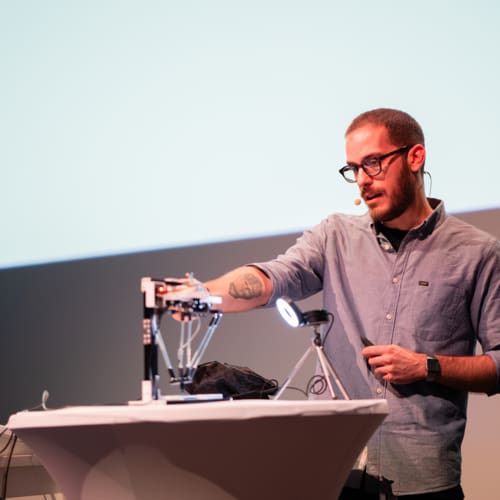
I’m Theodore, a software engineer, speaker and educator in Athens, Greece.
By day I’m a lead software engineer at Workable. Outside work I’m building Proxima Analytics, an open source, privacy-first analytics platform.
The parts of the web I like most are the ones that run into something else: creative coding, IoT, interaction design, and how people actually use computers.
For a decade, product teams were organized around a handoff: designers make mockups, engineers implement them. AI-native development is dissolving that boundary from both sides. Engineers ship UI without opening a design tool; designers ship working prototypes without waiting for sprint capacity; agents generate plausible interfaces from a sentence. The handoff is dying — but accountability for quality, consistency, accessibility, and user trust hasn’t gone anywhere.
This firechat puts a Principal Product Designer and a senior engineer on stage for a candid, unscripted conversation about what this shift actually looks like inside a product company shipping to thousands of customers:
The 70% problem. AI produces a convincing first draft of anything — UI, copy, code. Who is responsible for the last 30%, and how do teams stop “plausible” from shipping as “done”?
Design systems as APIs. When agents generate interfaces, a design system stops being a component library for humans and becomes a contract that machines consume: tokens, patterns, copy rules, accessibility standards. What does it take to make design knowledge machine-readable — and what silently breaks when you don’t?
Encoding judgment. Real production examples of converting institutional design knowledge into AI-consumable skills — including how a design team automated the rebranding of 400+ product illustrations across a legacy codebase with an AI pipeline (extraction → classification → ticket generation → automated application), and what that taught us about where humans stay in the loop.
What we each stopped doing. Which parts of the designer’s and the engineer’s job have already been absorbed by AI — and which parts became more valuable.
Where we disagree. Speed vs. craft, autonomy vs. review, and who should be allowed to ship UI in 2027.

1:1 mentoring sessions with experienced professionals from the Open Conf community. Pick a mentor below and book your slot: https://open-conf.gr/mentors-booking/
WE LEAD is an independent nonprofit organization empowering women to enter, grow, and lead in technology and innovation. During this community presentation, we will introduce our mission, programs, and impact, while sharing how we support women through free tech training, mentorship, career opportunities, and access to a strong professional network. Attendees will also discover how they can connect with and become part of the WE LEAD community.
Agenda:
• Introduction to WE LEAD and our mission
• How we support women entering, growing, and leading in technology
• Our programs, initiatives, and impact
• Ways to join and engage with the WE LEAD community
PUG Greece was launched in November 2025 with a simple goal: bring PostgreSQL users and enthusiasts in Greece together. By OpenConf, we will have organised three meetups featuring strong technical talks and built a community that is growing organically both online and offline.
This presentation tells the story of those first months—not as a polished success story, but as an honest look at what it takes to get a new PostgreSQL community moving.
An interactive workshop examines how AI reshapes professional identity, ownership, and responsibility, helping participants clarify their unique value and skills for an AI-driven workplace.
Learn how to use AI tools and plain English to turn an idea into a working website or app prototype without prior coding experience.
A hands-on workshop on using modern AI tools with WordPress for design, development, site management, and context-aware user experiences.
An interactive workshop examines how AI coding assistants and autonomous agents are reshaping software development, developer roles, and the skills needed to remain relevant.
A hands-on workshop on UI/UX for apps built with AI: build a first screen, critique it together, and fix the generic AI look.
Architectural Katas give teams repeated practice designing systems, defending decisions, and learning from alternative approaches to develop architectural judgment.