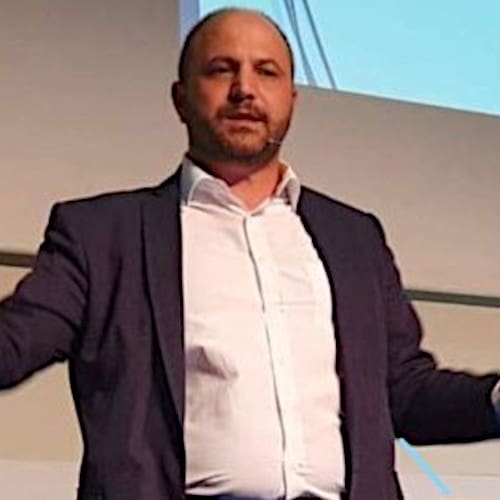
Grigoris Lemonis is an Executive Search and People Strategy professional with over 20 years of experience in Human Resources, organisational development and talent management. Holding an MSc in Occupational Psychology from the University of Strathclyde, he founded humani in 2018, a boutique Executive Search firm built on the belief that business performance starts with understanding people.
His work combines executive selection, organisational insight and behavioural assessment to help businesses address critical leadership and talent challenges. A strong advocate of ethical headhunting and human-centred technology, Grigoris believes that human intelligence, professional judgement and integrity must remain at the heart of every business decision.
AI is transforming software development, making coding, knowledge, and execution more accessible than ever. As AI evolves from a productivity tool into the interface between human intention and creation, a deeper question emerges: what does it mean to be a capable human in the age of AI?
When a junior engineer can achieve in hours what once required years of experience, what truly distinguishes a senior professional? Is it technical expertise, or the ability to exercise judgment, ownership, critical thinking, creativity, and empathy?
This panel explores how AI is reshaping careers, learning, leadership, and human value. Where does deep expertise still matter? What skills remain scarce when knowledge and execution become abundant? And how should developers, students, HR leaders, and CTOs prepare for a future where anyone can build, but not everyone can create value?
Audience takeaway: Understand how the definition of talent, expertise, and impact is changing, and what skills will matter most in the AI-native world.

Your AI agent has your credentials and access to production. Sooner or later it will do something it shouldn’t, because someone tricked it or because it simply got it wrong. Then someone will ask what happened, and you will have to prove it.
In this session you play the investigator. We take real incidents, from the coding agent that deleted a production database during a code freeze to the agent intrusion at Hugging Face, and ask the seven questions an investigator would ask. Hands up if your logs could answer them.
You leave with five things to fix in your agents on Monday, before you need the evidence.
1:1 mentoring sessions with experienced professionals from the Open Conf community. Pick a mentor below and book your slot: https://open-conf.gr/mentors-booking/
Agri-food supply chains face significant cybersecurity challenges due to fragmented information systems, limited interoperability, and vulnerabilities to data manipulation. Ensuring traceability, data integrity, and trust among stakeholders is therefore essential.
We explore how permissioned blockchain technology can enhance security and transparency across agri-food supply chains. Four key applications are examined: IoT-based cold-chain monitoring, tamper-evident digital certifications, smart contracts for automated transactions, and verifiable sustainability records.
The critical implementation challenges are addressed, including data reliability, identity and access management, privacy protection, interoperability, and deployment costs. Particular attention is given to the distinction between protecting the integrity of blockchain records and ensuring the accuracy of the original data.
Finally, how blockchain can be integrated into existing digital infrastructures as part of a broader cybersecurity framework, supporting more secure, transparent, and trustworthy agri-food supply chain is discussed.
WE LEAD is an independent nonprofit organization empowering women to enter, grow, and lead in technology and innovation. During this community presentation, we will introduce our mission, programs, and impact, while sharing how we support women through free tech training, mentorship, career opportunities, and access to a strong professional network. Attendees will also discover how they can connect with and become part of the WE LEAD community.
Agenda:
• Introduction to WE LEAD and our mission
• How we support women entering, growing, and leading in technology
• Our programs, initiatives, and impact
• Ways to join and engage with the WE LEAD community
An interactive workshop examines how AI reshapes professional identity, ownership, and responsibility, helping participants clarify their unique value and skills for an AI-driven workplace.
Learn how to use AI tools and plain English to turn an idea into a working website or app prototype without prior coding experience.
A hands-on workshop on using modern AI tools with WordPress for design, development, site management, and context-aware user experiences.
An interactive workshop examines how AI coding assistants and autonomous agents are reshaping software development, developer roles, and the skills needed to remain relevant.
A hands-on workshop on UI/UX for apps built with AI: build a first screen, critique it together, and fix the generic AI look.
Architectural Katas give teams repeated practice designing systems, defending decisions, and learning from alternative approaches to develop architectural judgment.